

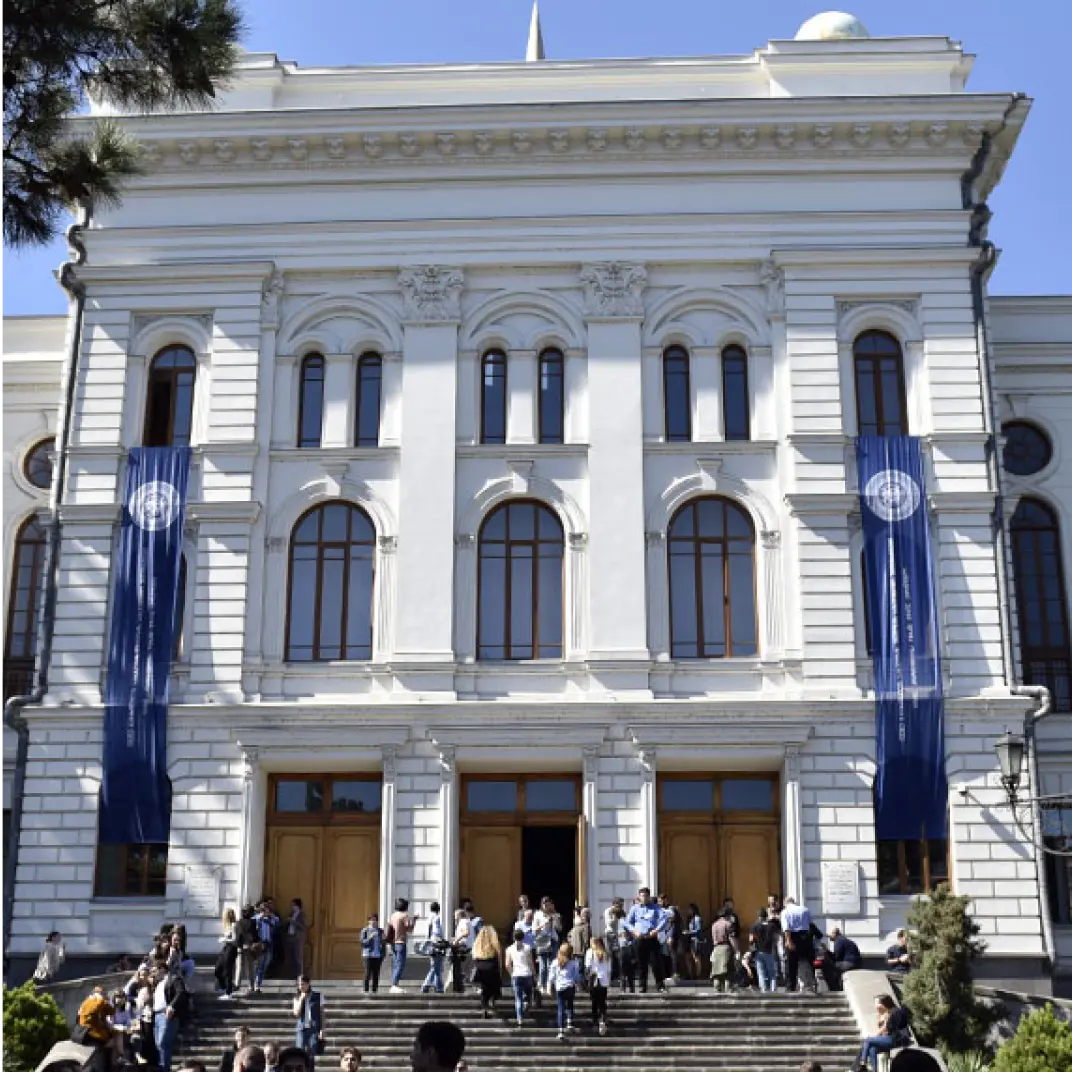
About Georgian National University SEU
Georgian National University SEU is one of the most distinguished universities in the higher education space of our country with a history of 20 years.
SEU has been focusing on development since its establishment. The University aims to create e university environment in line with international standards, where the synthesis and internationalization of strong theoretical, practical and research components in the learning process will ensure the training of competitive professionals for national and international markets.
In a short period of time, the University has been able to gain trust and popularity in the Georgian educational space – with educational programs meeting modern standards end requirements, with the efforts of highly qualified academic staff, effective teaching methods, introduction of new technologies and innovative approaches, which makes SEU very attractive for students and its graduates’ – for employers!
In 2009, SEU was accredited by the National Center for Education Accreditation, and in 2014 underwent re-authorization – which confirms the full compliance of the University with the goals of higher education in Georgia end the European Higher Education Area.
On June 10, 2021, the Council of Authorization of Higher Education Institutions unconditionally granted the authorization to Georgian National University SEU.
The members of the Authorization Council unanimously shared the dra report provided by the Panel of Authorization Experts, based on the SEU Self-Assessment Document and the information obtained by the Panel of Authorization Experts on the compliance of the SEU educational standards with the seven international standards.
At present, SEU has 4 faculties and 22 accredited (undergraduate, Master, single-step) educational programs in business, law, social sciences, tourism and medicine, where up to 11000 students study and employ up to 500 academic and visiting staff. The University takes care of the development and development of new educational programs in the field of business technologies. education, public administration and others.
The SEU academic team is staffed by highly qualified, deeply experienced competent professionals who actively use modern literature, technologies. the new teaching methods and motivate students in the teaching/ learning process to maximize self-realization.
The University has close partnerships wfth leading foreign higher education Institutions. diplomatic corps or international organizations, therefore, students have the opportunity to
participat’)’.ln exchange progrms, jo\pt research projects. training, adyancad or retraining
programs, etc. At the same time, foreign nationals are getting education et SEU, successful foreign professors, researchers and practicing professionals are involved in the academic process.
SEU is one of the most in-demand universities, as evidenced by the results of the Unified National Examinations and Mobility for 2014-2021. According to the data of the last 5 years, 5441 students have moved to SEU. which is a record number in Georgia. In the Unified National Examinations of 2021, with the first choice of entrants and the enrollment of students, in the “Top 1 o• of the most demanded private universities, SEU takes the honorable first place. And with the competition of all Georgian universities – it is the second. after Ivana Javakhishvili Tbilisi State University.
By employment rate of graduates SEU is among the ”Top 5″ universities !n order to promote the employment of students and graduates, employment forums are hekd annually, In which, as a rule, more than 150 successful companies of Georgia are representeo.
SEU is located in the historical part of Tbilisi. This side is interesting from the educational and tourist point of view, as well as, convenient for public transport.
In 2007, SEU offered students an impressive learning building that has l)ecome a symbol of modern Tbilisi. Since 2018, SEU Advantages has added a new, state-of-the-art and multifunctional campus with accumulated educational and technologies( resources, training and recreational spaces, which is a qualitatively different concept end has no analogues. Not only the building is built on the factor of student orientation, bQt: also its internal arrangement, which perfectly fits the goals of teaching-learningI, scier.tific, intellectual and creative activities. Computer spaces, conference rooms, conference 1:1.nd mock trial rooms and learning auditoriums are equipped with the latest ace-inventory and modern technologies, which differ from each other in shape and color, depenc!inJ.;J on the functional load.
One of the most distinctive places in the building is the library, whic,ti i.; located on two floors and includes all the necessary space for learning and research. outside the library, where you can spend your free time, relax and eat .. ke.e you w,11 find a large
terrace, from where you can enjoy the beautiful views of Tbilisi. In order to fun and maintain a healthy lifestyle, the building has a swimming pool , wher,e st:u.dents end staff can play football, basketball, rugby. volleyball. tennis and 9ther actfvfties. YotJ will meet many more interesting spaces on the campus. Soon, a new dormitory will be built near the building.
SEU hes the ambition and all the prerequisites to be tl’a leading t1rivat:e higher ecjuc_;ltion institution in the region.
At SEU Georgian National University
The innovation about the program design is that a Learning Organisation which includes policy makers, top management, academic staff, students, and businessmen has been created. A learning organisation concentrates on developing a shared vision between all its members – in our case, this is the pursuit of excellence. It encourages the sharing of mental models whilst developing the individual skills of the members.
It also actively promotes team learning. A repository of knowledge will be created where existing knowledge is stored for access by all staff. New knowledge and practices will also be sought out and incorporated into this repository. Thus, the SEU MBA will have its own knowledge management system where all knowledge and innovation is transferred into the program structure. If team members change or leave, the knowledge remains, and the MBA culture pervades. In this way, the program keeps its identity and can “grow”. In this sense, it can be called organic. It is the fact that the SEU MBA has been designed as such a learning organisation that gives the SEU MBA its distinctive, unique identity.
A feature of the learning organisation will be an annual bootcamp of two days, which will take place before the start of the academic year. Attendance will be compulsory for all academics teaching on the course. The bootcamp will consolidate the vision of the SEU MBA and how they are all part of a unique team. Staff will share their courses; discover where and how they complement each other and introduce new ideas. They will also discuss feedback from students and any problems with teaching or assessing. Sharing of best practice will be mandatory. Each bootcamp will have a theme connected to the MBA and wherever possible experts will be invited to disseminate latest practices. These bootcamps will guarantee sustainability, freshness and flexibility to the program.
Our program structure and design fits the working practices of the modern world and is open to traditional as well as lifelong learning students. The structure of the program consists of core components, elective courses and a research project in the form of master thesis.
Systems Thinking is regarded as the fifth discipline in the learning organisation as it underpins the other four disciplines of shared vison, personal mastery, mental models and team building. It stresses relationships and encourages new ideas. The whole (the MBA) is greater than the sum of its parts. (courses, staff) All academic staff have attended a short course in Systems thinking, each course is explored to find instances of such thinking. Staff has debated how to encourage students to use system thinking in the assignments. As the program starts functioning, feedback form students will also be scrupulously examined, and any mistakes will be acknowledged and remedied.
Organizational Development and Knowledge Management
Advances in technology and operational practice are making great demands on a company’s ability to survive. The message of the course of Organizational Development is that the culture of a company is heavily dependent on the way it is structured i.e. organisational design is a major contribution to its operational efficiency. Treating a company as an interconnected system is promoted as a useful way of managing organization based on this new approach. The collection, storage and interpretation of knowledge is crucial to the operational excellence of a company or corporation. There is therefore a need for a course on Knowledge Management which explores these issues. There is currently a move to embed the knowledge into the institution itself – called the learning organisation. This safeguards the company against the power of individual workers who could control key areas of knowledge and also promotes a culture where the institution promotes and provides the opportunities for teamwork as well as encouraging personal mastery. It also aims at common mental models and a shared company vision.
Systems thinking and making decisions
The modern corporate world is global, interconnected and complex. To deal with the problems that arise, a new way of thinking is needed away from the deterministic, logical, analytic approach used (successfully) by science. The central core course is Systems Thinking, which encourages thinking about the wider issues of any problem and incorporates the ideas of feedback and continuous change. The course explores different ways of thinking and examines in detail “System Thinking” as an answer to the problems of today. Three major System tools (Soft Systems methodology, System Dynamics and Viable Systems) are introduced.The course of Making Decisions complements the course of systems thinking helping students understand and overcome psychological as well as cultural obstacles in making decisions. It explores the biases and noise and shows the ways of how to overcome them. These two courses prepare a student’s mind set for right thinking and good decision-making.
Institutes List:
Managerial Economics and Research Methodology
We understand that our students might not have a background in business or economics based on their bachelor, so the course of Managerial Economics is a specially designed course that provides students with the appropriate economical knowledge necessary to complete the MBA. This course provides analytics tools that are needed to analyze the data. The course also includes applied economic theory and practice for managers and aspects of international trade and its regulations. The course integrates with the course on Research methodology. This course covers two directions, academic research (which prepares students for writing their master thesis) and applied research which enables students to investigate problems to be solved in the context of a company.
Organizational Development and Operational Excellence
The program uses latest technologies in process of teaching but it is not enough. Businesses are still run by humans, not robots and thus a new way of thinking is needed which can see the big picture, is creative and flexible and involves feedback and growth. Core courses in the first year of the study include Organizational Development and Operational Excellence, which cover the latest business practices from all over the world. Our program regards change as inevitable, it does not try to eliminate but it looks at ways of dealing with it, so all core courses cover the aspects of managing and implementing change. While organizational development analyses the structure that drives the behaviour, operational excellence proposes well-established directions towards excellence that have been proven successful with leading companies. The course sets performance measures and indicators so that the transformation towards change is well understood and measured and done while engaging the people in the given organization, as the change starts from the change of a mindset.
Knowledge Management, Leadership and Strategy and Green Agenda
Courses of Knowledge Management and Leadership and Strategy enable students to grasp the framework of organizational memory and establish learning organizations and incorporate the principles into business strategy supported by the necessary degree and involvement of leadership. Green Agenda is a significant part of the core courses that teach students how to assess the company footprint and adjust operations to grasp frontiers and alternatives of investing in green economy.
Research Methodology and Consulting and Delivering Projects – Master Thesis
As the course of Research Methodology teaches students how to conduct both academic as well as applied research for existing company problem, the course on Consulting and Delivering Projects is a uniquely structured course that allows students to learn from practice by being a part of an actual business project. This course is a continuation of the research methodology course which connects students to real business projects and provides necessary mentorship as they play assigned roles in the projects. Content, teaching methodology and assessment is co-coordinated by research specialist responsible for the quality of the applied research delivered and a specialist of project management responsible of students’ behaviour during planning and implementing the projects assigned. This creates a solid experience for the final stage of the MBA, a business-related research project, a Master Thesis, which is a significant part of the curriculum. This component explores the process and steps of planning and conducting research and uses modern software for analysis of the findings. An ideal thesis is one that is agreed between the student, the university and a business. We believe that the course of Consulting and Delivering Projects is an excellent preparation for high-quality Master Thesis that can be applied to real business problems. The students will work independently under a supervision of an academic mentor and a consultant from the business to deliver the analysis, solution and recommendation to the problem posed.
Employment Prospects
Most MBA programs have no trouble landing quality posts. Three months after graduating, more than 80% of MBAs usually find a position. Surveys show that in 2021, as with previous years, employment prospects for MBA graduates all over the world will continue this upward trend. Surveys also show that, with regard to job market prospects by industry, job level and job function, a graduate business degree unlocks employment opportunities in all industries, job functions, job levels, organizational sizes, and work locations. Prior to designing MBA program an additional study of local Georgian labour market regarding managerial positions conducted by the program coordinator confirms the similarity of local trends and it is incorporated into the program. Two studies were conducted at the Georgian labor market where 17 managerial positions were selected based on the vacancy post and job descriptions provided by the companies. Forty companies participated in the study, both local as well as international representing different industries in the Georgian market. After the detailed interviews with company representatives, the list of the necessary skills was identified in the direction of decision-making, involvement in operations, understanding the strategy, and effective communication as a means to fit into the company and relate to outside of the company. This list was used as one of the sources of data to design the MBA program.
The MBA is a career accelerator. It will be invaluable for those who wish to embark on their own career paths, mainly due to the skills it imparts to its students – systems thinking, strategic planning, global thinking, leadership, excellence and people management.
PROGRAM PARTNERS
➢ University of Turiba in Latvia
➢ University of Latvia
➢ Riseba University in Latvia
➢ Lazarsky University in Poland
➢ University of Gdansk in Poland
➢ State University of Applied Sciences Kalizs in Poland
➢ University of Economics and Human Sciences in Warsaw in Poland
➢ Polytechnic Institute of Bragança in Portugal
➢ Tor Vergata University of Rome in Italy
➢ Yeditepe University in Turkey
➢ BBW Hochschule Berlin in Germany
➢ Zwickau University of applied sciences in Germany
➢ IFIM Business School in India
➢ EU Business School in Switzerland
➢ Bucharest University of Economic Studies in Romania
➢ Klaipėda University in Lithuania
➢ College of CANYONS in USA
BBA COURSE DETAIL AT SEU GEORGIAN NATIONAL UNIVERSITY PROGRAM DESCRIPTION
The volume of the undergraduate program in Business Administration is 240 ECTS credits, the language of instruction is English.
The Bachelor’s program in Business Administration is built from simple to complex and from general disciplines to specific sub-disciplines, which includes the required number of disciplines required for the Bachelor of Business Administration qualification in the mandatory component of the program. It provides program selectivity by offering adequate, multiple-choice courses for undergraduate degrees in a variety of business disciplines, while enhancing practical and research skills by completing a practical and undergraduate thesis component, respectively.
The program is considered complete when the student accumulates 240 ECTS compatible with the program, which means mastering all the mandatory components of the program, and accumulating credits with elective components and free components, not less than the number of credits provided by this component. The program concludes with the award of a Bachelor of Business Administration degree.
The student receives information about the planning and progress of the educational process through the electronic learning process management system (www.emis.seu.edu.ge). Upon enrollment at the University, the student receives a login and password for the electronic learning process management system. He/she can undergo academic registration without coming to the university and has the academic freedom to enroll in the courses he / she prefers during the academic registration according to his / her educational program, have information about future courses, see course syllabus and evaluate each course according to the specifics.
Georgian National University SEU operates the European Credit Transfer and Accumulation System (ECTS). Credit is a unit that expresses the study load required for a student expressed in units of time – hours, which can be obtained after the achievement of learning outcomes. Credits are distributed among the components defined by the educational program and include the contact and independent hours required for the learning outcomes to be achieved with the specific component. Credit cannot be calculated by contact hours only. Contact hour refers to the time allotted for a student’s educational activity, which is realized by the involvement of the staff implementing the educational program component, while the independent hour is the time specified for the student’s educational activities, which does not include the involvement of the staff implementing the educational program component.
Student study load is the time required to achieve the learning outcomes defined by the educational program. Student study load is based on independent and contact hours. In SEU, a student’s workload for one academic year is 60 credits or 1500 hours, and one credit equals 25 hours. The student is entitled to accumulate additional credits during the academic year/semester, but not more than 75 credits per year.
The study component is one semester. The learning component with the same content, volume and learning outcome for students of all programs includes an equal number of credits. Credits are awarded based on the ability of the student with average academic achievement. The evaluation of the achievement of the learning outcomes of the components of the educational program should be completed in the same semester in which it was conducted.
A semester is a period of time that includes a combination of study weeks, an additional exam/exam period, and a student achievement assessment period for an additional exam/exam.
PROGRAM EMPLOYMENT FIELD
Graduate employment positions:
In the second semester of the study students take a core course of Career Path, that was created in cooperation and with involvement of partner employers. The objective of the course is to help students identify the choices of the pathways and learn more about the directions, possible positions and their role in organizational structure and context. The course will help students to learn more about their own personality traits and the values they match considering the pathways. As a result of this course students will be more informed about specific positions and career paths that fit them the most, they will also learn about what knowledge and skills they need to develop for being successful in chosen career path.
Graduates of the Business Administration bachelor’s educational program can be employed in public and private sector organizations, both, local and international. The positions that the graduates will be holding are specialists at department, middle level managerial positions or they may engage in entrepreneurial activity. The functions the graduates will be performing include organizational functions, administrative functions, various scale business processes management functions and information research and analysis.